US Colorectal Screening Rates Drop as Colonoscopy Access Favors Private Insurance
For more than a decade, public health campaigns have urged Americans to get screened for colorectal cancer starting at age 45. The message appeared to be working: screening rates inched upward through the 2010s, and deaths from the disease declined. But recent data from the Centers for Disease Control and Prevention and several cancer registries show a reversal. Screening rates are dropping overall—and the drop is almost entirely driven by people without private insurance.
A Widening Gap in Colorectal Screening
According to a 2025 analysis from the American Cancer Society, the proportion of adults aged 50–75 who reported being up to date with colorectal cancer screening fell from 72% in 2020 to 67% in 2024. The decline was steepest among uninsured adults, whose screening rate dropped from 42% to 34%. Among Medicaid enrollees, the rate fell from 58% to 51%. Meanwhile, privately insured patients held steady at around 78%.
The disparity is not new, but its widening is alarming. Colorectal cancer is the third most commonly diagnosed cancer in the United States and the second leading cause of cancer death. When caught early, the five-year survival rate exceeds 90%. When diagnosed after the cancer has spread, that rate falls below 15%.
“The drop in screening among the uninsured and Medicaid populations is a canary in the coal mine,” said Dr. Elena Torres, a gastroenterologist at the University of Texas MD Anderson Cancer Center, in an interview. “These are exactly the groups that need screening most—they often present with more advanced disease because they face barriers to care all along the pathway.”
National campaigns such as “80% in Every Community” had aimed to achieve an 80% screening rate in every population subgroup by 2025. That goal has not been met, and the gap between insured and uninsured has widened by several percentage points since 2020.
How Insurance Shapes Access to Colonoscopy
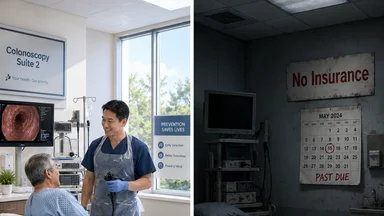
Colonoscopy is the most sensitive screening tool for colorectal cancer. It allows a physician to visualize the entire colon and remove precancerous polyps during the same procedure. But the test requires a specialist referral, prior authorization from the insurer, bowel preparation, sedation, and often a day off work. For patients with private insurance, these steps are usually covered with modest copays. For those on Medicaid or without insurance, each step can become a barrier.
Medicaid coverage for screening colonoscopy varies by state. As of late 2024, roughly a dozen states still require prior authorization for the procedure, even though the Affordable Care Act mandates that preventive services be covered without cost-sharing. In practice, many Medicaid managed care plans impose utilization management tools that delay or deny screening. A 2023 study in Health Affairs found that Medicaid beneficiaries were 30% less likely to complete a colonoscopy within six months of a positive stool test compared to privately insured patients.
Uninsured patients face even steeper hurdles. Without insurance, a screening colonoscopy can cost anywhere from $1,500 to $4,000. Some hospitals offer charity care or sliding-scale programs, but these are inconsistently available and often require lengthy application processes. Federally qualified health centers (FQHCs) provide some colonoscopy services, but capacity is limited.
The result is a two-tier system: those with private insurance can schedule a colonoscopy within weeks; those without may wait months or never get one at all. As screening rates drop in the lower tiers, the population-level benefit of early detection erodes.
The Biology of Early Detection and Why Timing Matters
Colorectal cancer typically develops slowly, over a period of 10 to 15 years, from precancerous adenomatous polyps. This long window makes it one of the most preventable cancers—if polyps are found and removed before they become malignant. Colonoscopy is the only screening method that can both detect and remove polyps in a single session.
The biological rationale for screening is straightforward: find the polyp, remove it, and the cancer never starts. Once a polyp becomes invasive, the cancer can grow through the bowel wall, enter the lymphatic system, and spread to distant organs. At that point, treatment becomes more complex and outcomes worsen.
Stage at diagnosis is the strongest predictor of survival. According to the National Cancer Institute’s Surveillance, Epidemiology, and End Results (SEER) database, the five-year relative survival rate for localized colorectal cancer is 91%. For regional spread, it drops to 72%. For distant metastasis, it falls to 13%.
Delayed screening directly increases the likelihood of later-stage diagnosis. A modeling study published in Gastroenterology in 2024 estimated that a 5% decline in screening rates over five years would lead to a 7–10% increase in the incidence of stage III and IV colorectal cancer, with corresponding increases in mortality. The effects would be most pronounced among Black and Hispanic populations, who already have higher colorectal cancer death rates.
Stool-Based Tests Offer a Cheaper Alternative—With Trade-offs
Not everyone needs a colonoscopy to be screened. The U.S. Preventive Services Task Force endorses several stool-based tests as effective alternatives, including the fecal immunochemical test (FIT) and the multitarget stool DNA test (Cologuard). These tests require no bowel preparation, no sedation, and no time off work. They can be done at home and mailed to a lab.
FIT is inexpensive—roughly $20 to $30 per test—and detects blood in the stool, which can be a sign of polyps or cancer. Its sensitivity for colorectal cancer is about 80%, but for advanced adenomas, it falls to roughly 25–40%. Cologuard, which costs around $600, combines FIT with DNA markers and has a sensitivity for advanced adenomas of about 42% in some studies.
The trade-off is that a positive stool test requires a follow-up colonoscopy. And that is where the access gap re-emerges. Patients without insurance or with limited Medicaid coverage may struggle to get that follow-up, defeating the purpose of initial screening. Data from the National Colorectal Cancer Roundtable suggest that completion rates for follow-up colonoscopy after a positive FIT are roughly 70% among privately insured patients, but only about 50% among uninsured and Medicaid patients.
Stool-based tests can improve overall screening rates because they are easier to complete. Several health systems have successfully mailed FIT kits to patients, achieving completion rates of 40–60% among those who had never been screened. But the downstream need for colonoscopy remains a bottleneck.
Another consideration is the interval between tests. FIT is recommended annually, while Cologuard is typically repeated every three years. Colonoscopy, if normal, is generally repeated every 10 years. Adherence to repeat testing is a challenge for all modalities, but may be particularly difficult for populations with unstable insurance coverage or limited primary care access. A patient who completes a FIT one year might not receive a reminder the next year if they change addresses or lose coverage.
What the Drop in Screening Rates Actually Means
If screening rates continue to decline, the consequences will be measured in avoidable deaths. A 2025 analysis from the American Cancer Society estimated that a sustained 5% drop in screening would lead to roughly 2,400 additional colorectal cancer deaths per year in the United States—a 4% increase in mortality. The impact would be heaviest in communities with low baseline screening rates.
The disparity is already visible in cancer outcomes. Black Americans have a colorectal cancer incidence rate roughly 20% higher than white Americans and a death rate about 35% higher. Hispanic Americans have similar incidence but are more likely to be diagnosed at a late stage. These gaps are driven partly by differences in screening access, but also by delays in follow-up and treatment after diagnosis.
“Screening is only the first step,” said Dr. Torres. “If you screen someone and they can’t get a colonoscopy after a positive test, you’ve created anxiety without benefit. The system has to support the full pathway.”
Recent changes in clinical guidelines may also affect screening rates. In 2021, the U.S. Preventive Services Task Force lowered the recommended starting age for colorectal cancer screening from 50 to 45. That change expanded the eligible population by roughly 20 million people, many of whom are uninsured or underinsured. Without corresponding increases in access, the guideline change may widen the gap between who should be screened and who actually is.
System-Level Levers That Could Close the Gap
Policy changes could address the screening disparity, though each comes with trade-offs. One straightforward step is eliminating prior authorization for screening colonoscopy in Medicare and Medicaid. Several states have already done so for Medicaid, and early evidence suggests it increases completion rates. A 2024 study from California found that after the state removed prior authorization for colonoscopy, screening rates among Medicaid enrollees rose by 11% over two years.
Another lever is expanding mailed FIT kit programs to uninsured populations. Some health systems, including Kaiser Permanente and the Veterans Health Administration, have achieved high screening rates by mailing FIT kits to patients who are overdue. Scaling this approach to community health centers and safety-net hospitals could reach many of the unscreened. However, the cost of the kits and the need for follow-up colonoscopy remain barriers.
Patient navigation programs—where staff help patients schedule appointments, arrange transportation, and complete bowel preparation—have been shown to increase colonoscopy completion rates by 20–30% in underserved populations. These programs are relatively low-cost, but they require sustained funding. The Centers for Disease Control and Prevention’s Colorectal Cancer Control Program has supported navigation in several states, but funding is limited and not guaranteed.
Aligning quality metrics across payers could also help. Many health plans track screening rates as a quality measure, but the metrics often exclude patients who are not in the plan for a full year, or they count only colonoscopy rather than stool tests. Standardizing the measure to include any recommended screening could reduce administrative burden and encourage more flexible approaches.
Some experts argue that the focus on colonoscopy as the gold standard may itself be a barrier. “We need to destigmatize stool-based tests,” said Dr. Mark Pochapin, a gastroenterologist at NYU Langone Health, in a 2024 podcast. “A perfect colonoscopy that never happens is worse than a good FIT that gets done.” But others caution that relying too heavily on stool tests could lead to missed polyps and false reassurance.
Another policy lever is expanding Medicaid in states that have not yet done so. As of 2025, roughly 10 states have not expanded Medicaid under the Affordable Care Act. In those states, adults with incomes below the federal poverty line often fall into a coverage gap—they earn too much for traditional Medicaid but too little for subsidized private insurance. Expanding Medicaid would provide coverage for millions of uninsured adults, including coverage for preventive services like colorectal cancer screening. A 2023 study in JAMA Health Forum found that Medicaid expansion was associated with a 3–4 percentage point increase in colorectal cancer screening rates among low-income adults.
Practical Takeaways for Patients and Clinicians
For patients who face insurance barriers, the first step is to ask about stool-based screening. A FIT kit can be obtained through a primary care clinic or, in some states, through public health programs. The cost is low, and the test can be done at home. If the result is positive, many hospitals have charity care programs that can cover a follow-up colonoscopy.
Clinicians can play a key role by recommending screening even when a patient lacks insurance. Primary care practices can integrate screening reminders into electronic health records and offer FIT kits during routine visits. Some practices have adopted a “mailed FIT” approach, where patients who are overdue for screening receive a kit at home with instructions. This approach has been shown to increase screening rates by 10–20% in some settings.
Community health centers often offer sliding-scale screening programs. The Health Resources and Services Administration (HRSA) requires all FQHCs to provide preventive services regardless of ability to pay. Patients can find their nearest center through the HRSA website. For patients with private insurance, scheduling a colonoscopy remains the most effective option, and most plans cover it as a preventive service with no copay.
For clinicians, the key message is to offer some screening rather than waiting for the ideal test. A patient who completes a FIT this year is better off than one who delays colonoscopy for two years. And for patients with private insurance, scheduling a colonoscopy remains the most effective option. The same principle applies to cancer screening: access matters as much as efficacy.
In summary, the decline in colorectal cancer screening rates is a warning sign that the US healthcare system is failing to deliver equitable preventive care. Without targeted policy interventions and a willingness to embrace multiple screening modalities, the disparities in screening access will translate into preventable deaths. The evidence is clear: early detection saves lives, but only if everyone can access it.
This article is for informational purposes only and does not constitute medical advice. Individuals should consult their healthcare provider for personalized screening recommendations.