Kenya Public Insurance Denies Schizophrenia Injections While Private Clinics Stock Them
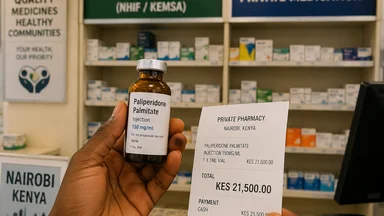
On a Tuesday morning in March 2025, a 34-year-old man with schizophrenia walked into a private pharmacy in Nairobi's Westlands district. He handed over a prescription for paliperidone palmitate, a long-acting injectable antipsychotic that controls his symptoms for a month. The pharmacist prepared the dose and asked for 8,500 Kenyan shillings—roughly US$65. The man paid out of pocket. His public insurance, the National Hospital Insurance Fund (NHIF), had refused to cover the injection. His doctor had submitted a prior-authorization request twice. Both times, NHIF denied it.
Insurance Denial at a Nairobi Clinic
Dr. Grace Wanjiku, a psychiatrist at a Nairobi outpatient clinic, sees this scenario several times a month. She prescribes depot antipsychotics—paliperidone palmitate or haloperidol decanoate—for patients with schizophrenia who struggle with daily oral pills. “I have patients who are stable on these injections for years,” she said. “But when they lose their private insurance or switch to NHIF, they have to stop. Within a few months, they relapse.”
NHIF, Kenya’s public health insurer, covers outpatient and inpatient care for most Kenyans, but its formulary explicitly excludes long-acting injectable antipsychotics. The fund’s 2024 list of reimbursable medicines includes oral antipsychotics like olanzapine, risperidone, and haloperidol tablets, but not their injectable equivalents. Clinicians say the reason is cost: a single dose of paliperidone palmitate runs around US$80 at private pharmacies, compared to roughly US$10 for a month’s supply of oral risperidone.
“NHIF argues that oral medications are cheaper and sufficient,” said Dr. Wanjiku. “But for many patients, oral adherence is below 50% within six months. The injection is not a luxury; it’s a necessity.” She estimates that about one in five of her patients with schizophrenia would benefit from a depot formulation, but fewer than one in ten receive it because of insurance barriers.
The denial process is opaque. Clinicians submit a prior-authorization form with a diagnosis and justification, but NHIF rarely provides a written reason for rejection. “We just get a ‘not covered’ message in the system,” said a pharmacist at a public hospital who spoke on condition of anonymity. “There is no appeal mechanism that works within the time a patient needs the next dose.”
For patients who cannot afford the injection out of pocket, the consequence is often a gradual decline. One of Dr. Wanjiku's patients, a 28-year-old woman who had been stable on paliperidone for 18 months, lost her private insurance after her employer changed providers. She switched to NHIF, which covered only oral risperidone. Within two months, she stopped taking the pills regularly—she said they made her feel drowsy and she often forgot the evening dose. She was hospitalized with acute psychosis three months later. “Her family spent more on the hospitalization than a year of injections would have cost,” Dr. Wanjiku noted.
NHIF's Formulary Gap for Severe Mental Illness
NHIF’s exclusion of depot antipsychotics is not an oversight. The fund’s formulary committee, which includes Ministry of Health officials and pharmacists, has discussed adding them multiple times since 2020, according to two people familiar with the deliberations. Each time, the committee cited budget constraints. “The cost per patient per year for paliperidone is around US$1,000,” said a former NHIF advisor. “For oral risperidone, it’s about US$120. The committee felt the savings from reduced hospitalizations were not proven enough to justify the upfront cost.”
The World Health Organization (WHO) recommends depot antipsychotics as a first-line option for maintenance treatment in schizophrenia, particularly when adherence is a concern. In its 2023 Model List of Essential Medicines, the WHO includes fluphenazine decanoate and haloperidol decanoate as long-acting injectables. Yet Kenya’s national essential medicines list, which guides NHIF coverage, has not been updated to include them since 2021.
The gap affects patients across the severity spectrum. For someone with well-controlled schizophrenia, missing a single oral dose can trigger a cascade of paranoia and disorganization. A depot injection ensures a steady drug level for weeks. “I had a patient who was a university lecturer, stable on paliperidone for two years,” said Dr. Wanjiku. “He lost his private job-based insurance when the company downsized. NHIF didn’t cover the injection. Within three months, he was hospitalized with psychosis. He lost his job.”
NHIF does cover some injectable medications for other conditions, such as insulin for diabetes and certain cancer biologics. Mental health advocates argue that the fund’s treatment of depot antipsychotics reflects a broader devaluation of psychiatric care. “If insulin were excluded, there would be an outcry,” said a Nairobi-based mental health activist. “But schizophrenia patients don’t have the same voice.”
The activist pointed out that diabetes and schizophrenia are both chronic conditions with well-established treatment protocols. Yet the stigma around mental illness means fewer patients and families advocate publicly. “We don't see marches or media campaigns for depot coverage,” she said. “The silence allows the status quo to persist.”
Private Sector Stockpiles What the Public System Omits
While NHIF denies depot antipsychotics, private insurers in Kenya routinely cover them. Avenue Healthcare, a leading private insurer, includes paliperidone palmitate and other long-acting injectables on its formulary without prior authorization, according to a company spokesperson. AAR Insurance also covers them, though it requires a doctor’s justification. The difference is stark: a patient with private insurance pays a monthly premium of around US$50–150, and the injection costs little out of pocket beyond a copay of roughly US$10–20.
Private clinics in Nairobi’s upscale neighborhoods, such as the Aga Khan University Hospital and Nairobi Hospital, stock depot antipsychotics in their pharmacies. The medications are imported by distributors like Medisys and Dawa Limited, which supply both public and private facilities. But public hospitals often do not order them because they know NHIF will not reimburse the cost. “We have paliperidone in our pharmacy, but we only dispense it to patients who pay cash or have private insurance,” said a pharmacist at a county hospital in Nairobi. “NHIF patients cannot get it here.”
The price premium for depot formulations over oral medications is roughly 30–50% at the wholesale level, but the gap widens at the pharmacy counter. A patient with private insurance might pay nothing for an injection; an uninsured patient pays the full retail price, which can exceed US$100 at some pharmacies. For many Kenyans earning less than US$200 per month, that is prohibitive.
The result is a two-tier system where treatment modality depends on insurance status, not clinical need. A patient with a high-deductible private plan might still face a large copay, but most private policies cover injectables as part of their outpatient prescription benefit. “We see patients who switch from private to public insurance and immediately decompensate,” said a social worker at a mental health NGO in Nairobi. “It’s a predictable pattern.”
The social worker recounted a case of a 45-year-old man who had been on haloperidol decanoate for five years, working as a security guard. When his company changed insurance providers, his new plan was NHIF-based. The depot was no longer covered. His wife tried to pay out of pocket for two months, but the cost was too high. He switched to oral haloperidol, but within weeks he stopped taking it regularly. He lost his job after showing up late and confused. “His wife now brings him to our clinic every month, begging for samples,” the social worker said. “We can only give a few doses from donations.”
Relapse Rates Rise When Injectables Are Unaffordable
Data from a 2024 study conducted at Mathari Hospital, Kenya’s largest psychiatric facility, illustrates the consequences. Researchers followed 240 patients with schizophrenia over 12 months, comparing those on oral antipsychotics with those on depot formulations. Adherence—defined as taking at least 80% of prescribed doses—was 42% in the oral group and 83% in the depot group. Relapse, defined as rehospitalization or symptom exacerbation requiring a dose increase, occurred in 38% of the oral group and 16% of the depot group.
“The adherence gap is not about motivation; it’s about the nature of the illness,” said Dr. Samuel Mwangi, a psychiatrist at Mathari and a co-author of the study. “Schizophrenia affects insight and memory. A patient may genuinely intend to take their pills but forget half the time. The depot removes that barrier.” The study estimated that the cost of a single hospitalization for psychosis at Mathari is around US$300–500, often exceeding the annual cost of depot injections for a patient who would otherwise relapse.
NHIF ends up paying for many of those hospitalizations. A 2023 analysis by the Kenya Mental Health Alliance found that NHIF spent approximately US$4.2 million on schizophrenia-related inpatient care that year, with an average stay of 14 days. The same report estimated that expanding depot coverage could reduce hospitalization rates by roughly 30%, saving the fund about US$1.3 million annually—more than the cost of the injections themselves.
“The irony is that NHIF’s cost-saving measure ends up costing more,” said Dr. Mwangi. “But the fund’s budget is siloed. The inpatient budget is separate from the outpatient pharmacy budget. So the savings don’t show up on the same spreadsheet.”
Critics of depot expansion point out that not all patients need injectables. Some patients do well on oral medications, and the upfront cost of depots is higher per dose. “There is a legitimate debate about cost-effectiveness,” said a health economist at the University of Nairobi who asked not to be named. “But the current policy is a blanket exclusion, not a targeted one. NHIF doesn't assess which patients would benefit most. It just says no.” A targeted approach—covering depots only for patients with documented adherence problems—might be more efficient, but it would require a functioning prior-authorization system that NHIF currently lacks.
County Hospitals Lack Psychiatrists and Depots
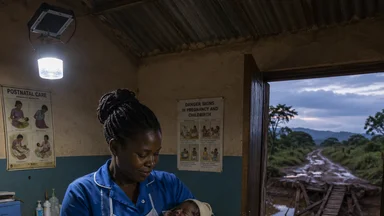
Kenya has roughly 0.19 psychiatrists per 100,000 population, according to the Ministry of Health’s 2024 human resources report. That means most county hospitals—especially in rural areas like Turkana, Marsabit, and Kwale—have no psychiatrist on staff. Clinical officers and nurses manage mental health patients, often with limited training in depot injection techniques or dosing schedules.
Even if NHIF were to cover depot antipsychotics, rural facilities would face logistical hurdles. The medications require cold-chain storage—paliperidone palmitate must be kept between 2°C and 8°C—which many county hospitals lack. “Our refrigerator broke last month,” said a nurse at a health center in Makueni County. “We had to throw away vaccines. We cannot store expensive injectables under those conditions.”
Kenyatta National Hospital in Nairobi, a public tertiary facility, stocks depot antipsychotics and administers them to patients who can afford them or have private insurance. But for a patient in rural Homa Bay County, traveling to Nairobi costs roughly US$20–30 by bus—more than the copay for the injection itself. Many patients simply do not come.
The lack of psychiatrists also means that depot prescribing is concentrated in urban centers. “I train clinical officers in basic mental health care, but depot initiation is complex,” said Dr. Wanjiku. “You need to know the loading dose, the injection interval, how to manage side effects. Most clinical officers have never done it.” A 2022 survey of 47 county hospitals found that only 12 had staff trained to administer depot antipsychotics.
One potential solution is to use mobile health teams that travel to rural areas to administer depots. A pilot program in Uganda's Jinja district used community health workers to identify patients on oral medications with poor adherence, then brought them to a central clinic for a depot injection every month. Adherence improved from around 40% to 75% over six months. Kenya's Ministry of Health has discussed a similar program for the Lake Region Economic Bloc, but funding has not been allocated.
Policy Fixes That Could Close the Gap
Adding depot antipsychotics to NHIF’s essential medicines list would be the most direct fix. The Kenya Mental Health Policy 2025–2030, launched in early 2025, includes a pledge to “expand access to long-acting injectable antipsychotics for schizophrenia patients in public facilities.” But implementation has been slow. The policy document does not specify a timeline or budget line.
Bulk procurement through the Kenya Medical Supplies Authority (KEMSA) could reduce the price by roughly 20%, according to estimates from the Ministry of Health. KEMSA already procures oral antipsychotics at discounted rates; a similar arrangement for depots would bring the per-dose cost closer to US$50–60. Some advocates have proposed a tiered pricing model, where NHIF covers the injection but patients pay a small copay of around US$5–10.
Task-sharing could also help. In several sub-Saharan African countries, including Uganda and South Africa, trained nurses and clinical officers administer depot antipsychotics under supervision. Kenya’s 2023 Mental Health Task Force recommended expanding this practice, but regulatory barriers remain. The Nursing Council of Kenya has not yet approved depot administration as part of the scope of practice for nurses.
“The policy is there, but the operational details are missing,” said a Ministry of Health official who spoke on condition of anonymity. “We know what needs to happen. The question is whether the political will and the budget will align.”
Another approach is to negotiate with manufacturers for lower prices. In 2024, the Clinton Health Access Initiative (CHAI) facilitated a deal that reduced the price of paliperidone palmitate in several African countries by roughly 15%. Kenya did not participate, but advocates say the government could join future negotiations. “If NHIF committed to covering depots, the volume would increase, and prices would come down,” said the health activist.
What a Uniform Formulary Would Mean for Patients
A standardized formulary across all insurers—public and private—would eliminate the current patchwork. If NHIF covered depot antipsychotics, every patient with schizophrenia would have access to the same treatment options, regardless of income or employer. The estimated annual cost to NHIF would be around US$2–3 million, based on the roughly 3,000 patients who would likely use depots. The savings from reduced hospitalizations would offset a significant portion.
For a patient like the 34-year-old man in Westlands, uniform coverage would mean stability. He could return to work, rebuild relationships, and avoid the cycle of relapse and rehospitalization. His family would not have to choose between his medication and other essentials. “Schizophrenia is a chronic illness, like diabetes or hypertension,” said Dr. Mwangi. “We don’t ask diabetics to pay for insulin out of pocket if they have insurance. Why do we ask schizophrenia patients to pay for the treatment that keeps them stable?”
Other low- and middle-income countries face similar dilemmas. Ghana’s National Health Insurance Scheme covers depot antipsychotics. South Africa’s public sector includes them in its essential medicines list. Kenya’s exclusion places it behind regional peers. “This is not an unsolvable problem,” said the health activist. “It requires a decision at the top.”
The gap between public denial and private access is not a technical failure; it is a policy choice. Until NHIF revises its formulary, thousands of Kenyans with schizophrenia will continue to relapse, fill emergency rooms, and lose their footing—not because effective treatment does not exist, but because their insurance says no.
This article is for informational purposes only and does not constitute medical advice. Individuals should consult a qualified healthcare professional for personal health decisions.