One Untracked Stellar Population Model Rerouted a Galaxy Evolution Timeline
For decades, the standard story of how massive elliptical galaxies formed seemed straightforward: they assembled most of their stars in a rapid burst early in cosmic history, around redshift 3 or 4, then settled into a quiet, passive existence. This picture came from single stellar population (SSP) models—tools that treat a galaxy's starlight as coming from one generation of stars with a single age and metallicity. But a growing body of evidence suggests that this tidy narrative is missing a crucial ingredient: stars born not in the main galaxy, but in smaller dwarf galaxies that later merged into it. When those accreted stars go untracked, the inferred formation timeline can be off by billions of years.
When a Stellar Population Model Missed the Ghosts
Single stellar population models are the workhorses of extragalactic astronomy. Given an integrated-light spectrum of a galaxy, an SSP fit returns a single age and a single metallicity—essentially assuming that all stars formed at the same time from gas of the same composition. For early-type galaxies, which have little ongoing star formation and smooth, featureless spectra, this assumption seemed reasonable. The resulting ages clustered around 10–12 billion years, implying formation redshifts of 3 or higher.
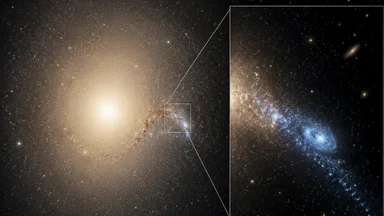
But the assumption glosses over a key detail: galaxies grow not only by forming stars in situ, but also by accreting stars from smaller systems that they swallow. Dwarf galaxies have their own star formation histories, often extending to later cosmic times. When a dwarf merges with a massive elliptical, its stars—chemically distinct and younger—become part of the larger galaxy's stellar population. An SSP model that sees only the combined light will interpret the younger stars as a signal that the entire galaxy formed later, or it will average them out, skewing the derived age.
The problem is not subtle. As early as the 1990s, studies of the Milky Way's stellar halo revealed that many of its stars originated in accreted dwarf galaxies—the most famous example being the Sagittarius dwarf, which is still being torn apart. But for distant ellipticals, where individual stars cannot be resolved, the accreted component remained invisible in integrated light.
Only in the past decade have astronomers begun to quantify how large this missing fraction really is. The implications are now forcing a re-evaluation of the canonical timeline of galaxy formation.
The Chemical Tagging Clue That Broke the Assumption
Chemical tagging—the practice of using abundance patterns to trace stars back to their birth environments—provided the first clear evidence that accreted stars are a significant component in massive galaxies. A landmark study by Kirby et al. in 2016 analyzed over 200 stars in eight dwarf spheroidal galaxies around the Milky Way. They found that 5–10% of stars in these dwarfs have distinct iron-to-hydrogen ratios ([Fe/H]) and alpha-element abundances ([α/Fe]), indicating they formed later than the bulk of the dwarf's population.
These chemically peculiar stars are not native to the dwarf; they are thought to have been born in even smaller systems that the dwarf itself accreted. When the dwarf later merges with a larger galaxy, those stars become part of the accreted population of the final system. The effect is multiplicative: each merger brings its own accreted stars, so the final fraction of ex situ stars in a massive elliptical can be large.
The chemical tagging approach works because star formation in dwarf galaxies proceeds differently than in massive ones. Dwarfs have lower metallicity and typically form stars over longer periods, sometimes extending to low redshift. When those stars are later mixed into a massive elliptical, their distinct chemical signatures persist, even if the stars themselves are too faint to see individually.
Neglecting this accreted component shifts the inferred formation redshift by roughly 1–2 units. For a galaxy that appears to have formed at z ≈ 3.5 under an SSP model, including the accreted stars can lower the median formation redshift to z ≈ 2.5—a difference of about 1.5 billion years. That is enough to change the interpretation of when and how the galaxy assembled.
How a Single Free Parameter Rerouted the Timeline
Classic models of early-type galaxy formation posited that most stars formed in a monolithic collapse at z ≈ 3–4, followed by quiescence. This picture was supported by SSP fits to optical spectra, which gave old ages. But when astronomers began to include an accreted component in their models—essentially adding a free parameter for the fraction of stars that formed ex situ—the derived formation times shifted downward.
A series of studies using cosmological simulations, such as Illustris and EAGLE, quantified the effect. In the TNG50 simulation, for galaxies with stellar masses around 10^11 solar masses, the accreted fraction reaches roughly 50%. For the most massive ellipticals, with masses above 10^11.5 M☉, the fraction can be even higher. The median formation redshift for the in situ stars remains high, but when accreted stars are included, the overall median formation redshift drops to z ≈ 2–2.5.
The effect size is substantial: roughly 30–40% of stars in massive ellipticals are accreted, according to estimates from Rodriguez-Puebla et al. (2017) in Monthly Notices of the Royal Astronomical Society. That means a significant portion of the stellar mass formed later than the classical picture assumed. The timeline shift is about 1–2 billion years for half the stars in a typical massive elliptical.
This is not a minor correction. It changes the inferred star formation rate density at z ≈ 2, a critical epoch when the universe was about 3 billion years old. It also affects comparisons with dark-matter halo growth curves, which show halos assembling later than the old stellar ages suggested.
To illustrate the magnitude, consider a massive elliptical with a stellar mass of 10^11.5 M☉. If 40% of its stars are accreted and those accreted stars have a median formation redshift of z ≈ 1.5, while the in situ stars formed at z ≈ 4, the overall median formation redshift becomes roughly z ≈ 2.5. This is not just a shift in numbers—it changes the inferred star formation history of the universe. The cosmic star formation rate density at z ≈ 2, which is a key constraint for galaxy formation models, would need to be revised upward to account for the stars that were previously thought to have formed earlier.
From Dwarf Galaxies to Massive Ellipticals: The Diffusion Path
The idea that accreted stars matter did not originate in studies of massive ellipticals—it came from detailed work on the Milky Way's dwarf satellite galaxies. In the 2000s, chemical tagging surveys of Local Group dwarfs began to reveal multiple stellar populations within individual galaxies. The technique then diffused into the simulation community, where it became clear that cosmological simulations naturally produce large accreted fractions.
The Illustris simulation, published in 2014, was among the first to track the origin of stars in massive galaxies. Its successor, IllustrisTNG (TNG50), refined the analysis, showing that accreted fractions increase with stellar mass. The EAGLE simulation, also from the mid-2010s, found similar trends. These simulation results motivated observational tests using stacked images from the Sloan Digital Sky Survey (SDSS), which revealed extended stellar halos around ellipticals—halos that are likely composed of accreted stars.
The key observational paper by Rodriguez-Puebla et al. (2017) combined SDSS data with semi-empirical models to estimate accreted fractions as a function of mass. They found that for galaxies with stellar masses above 10^11 M☉, the accreted fraction exceeds 30%, and for the most massive systems, it approaches 50%. This work bridged the gap between simulation predictions and observable properties.
The diffusion path shows how a concept that began in the Local Group—where individual stars can be resolved—moved into the realm of distant galaxies, where only integrated light is available. It is a case study in cross-disciplinary method transfer, from resolved stellar populations to cosmological simulations to statistical analyses of survey data.
The Practical Fix: Resolved Stellar Populations in Integrated Light
Once the problem was recognized, the question became: how can we correct for the missing accreted component when we cannot resolve individual stars in distant galaxies? The most direct solution is to use resolved stellar populations where possible. The Hubble Space Telescope and, more recently, the James Webb Space Telescope have resolved stars in roughly 100 nearby early-type galaxies, providing color-magnitude diagrams that reveal multiple age populations. For these systems, the accreted fraction can be measured directly.
For the vast majority of galaxies that are too distant for resolved imaging, astronomers have turned to full spectral fitting with flexible star formation history (SFH) priors. Instead of assuming a single burst, these models allow for multiple episodes of star formation, including a late component that can represent accreted stars. Software packages like Prospector, Beagle, and Bagpipes now include the option to fit for an accreted fraction, using priors informed by simulations.
These methods are not without controversy. The fits can be degenerate: a burst of star formation at z ≈ 2 can mimic the spectral signature of an older population diluted by younger accreted stars. Priors matter enormously. Some groups argue that the data are consistent with a single old population if the accreted fraction is small, while others find that including accretion improves the fit significantly.
The practical fix is still a work in progress. But the consensus is moving toward the view that any model that ignores accretion is likely to overestimate the age of the stellar population, especially for the most massive galaxies.
An additional challenge is that the accreted fraction itself is not constant—it varies with galaxy mass, environment, and cosmic time. For instance, galaxies in dense clusters may have higher accreted fractions due to more frequent mergers, while isolated ellipticals may have lower fractions. This means that a one-size-fits-all correction is insufficient; models need to account for these dependencies. Some recent work has attempted to calibrate the accreted fraction using machine learning on simulation data, but these methods are still being tested against observations.
What the Corrected Timeline Means for Galaxy Formation Theory
The corrected timeline—with median formation redshifts around 2–2.5 for massive ellipticals—aligns better with theoretical expectations from cold-mode accretion. In this picture, gas flows along cold filaments into dark-matter halos, fueling star formation until relatively late times. The old SSP ages were in tension with this model, requiring that star formation shut off earlier than the gas supply would allow.
The new ages also reduce a long-standing discrepancy between observed stellar masses and the growth of dark-matter halos. In the standard ΛCDM cosmology, halos assemble hierarchically, with the most massive halos forming later. If stellar ages were as old as the SSP models suggested, then stars would have formed before their halos were fully assembled—a timing problem. With the accreted fraction accounted for, stellar ages and halo assembly times come into closer agreement.
There is also an implication for quasar feedback models. Some simulations require strong feedback from active galactic nuclei to suppress star formation in massive galaxies at late times. If the stars are actually younger, the feedback may not need to be as aggressive, reducing the tension between observed and simulated quasar luminosities.
The next step is to apply these corrected models to JWST NIRSpec data at z > 3, where the universe was less than 2 billion years old. Early JWST results have already revealed surprisingly massive galaxies at high redshift, and the accreted fraction may play a role in interpreting those observations. If a galaxy at z = 5 appears to have a stellar mass of 10^11 M☉, part of that mass could be accreted from smaller systems that formed even earlier—or later. Untangling this will require the same cross-disciplinary approach that brought the accreted component to light in the first place.
Moreover, the corrected timeline has implications for the chemical enrichment history of the universe. If a significant fraction of stars in massive ellipticals formed later than previously thought, then the production of heavy elements like iron and oxygen must have been delayed as well. This could affect our understanding of the chemical evolution of the intergalactic medium and the metal enrichment of galaxy clusters. Some models of cluster chemical abundances have assumed early enrichment from massive ellipticals, but if those galaxies formed later, the enrichment may have been more gradual.
Another area of impact is the interpretation of gravitational-wave sources. The merger rates of binary black holes depend on the star formation history of their host galaxies. If massive ellipticals formed later, the delay time distribution for black hole mergers could shift, affecting predictions for LIGO and Virgo detection rates. While this is a secondary effect, it illustrates how a seemingly narrow technical issue in stellar population modeling can ripple across astrophysics.
The story of the untracked stellar population model is a reminder that the tools we use to interpret data carry hidden assumptions. Single stellar population models are not wrong—they are incomplete. The missing parameter, once included, rerouted a timeline that had seemed settled for decades. That is how science often works: not by revolution, but by the slow, cumulative discovery of what we have been leaving out.