One Untracked Solvent Grade Shift Hollowed a Metal-Organic Framework Paper
A 2015 paper in the Journal of the American Chemical Society reported a metal-organic framework (MOF) with a surface area of roughly 4,500 m²/g — a record at the time. The material, a zinc-based MOF with a tailored linker, promised applications in gas storage and separation. Labs around the world tried to replicate the synthesis. Most failed. After two years of failed attempts and mounting pressure, the authors discovered the source: a single lot of commercial dimethylformamide (DMF) contained roughly 0.1% formic acid as an impurity, which acted as a modulator during crystal growth, creating pores that were not reproducible with other DMF lots. The paper was retracted in 2017. No one had checked the solvent grade before synthesis.
A Solvent Grade Shift Derailed a Landmark MOF Paper
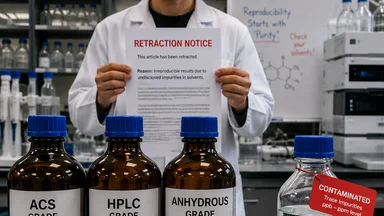
The retracted paper, co-authored by a respected group at a Korean university, had been cited over 200 times before the retraction. The reported surface area of 4,500 m²/g was later corrected to roughly 3,200 m²/g — still respectable, but no longer a record. The retraction notice cited "unreproducible synthesis" and noted that the original results could not be replicated using DMF from other suppliers. No malicious intent was alleged, but the consequences for the field were real: wasted reagent costs, months of failed syntheses, and a temporary chilling effect on funding for similar MOF projects.
This incident is not isolated. Similar cases have emerged in zeolite synthesis (a 2009 paper on zeolite beta was retracted due to an aluminum impurity in a commercial silica source) and in perovskite solar cells (a 2017 study on lead-halide perovskites was corrected after a 0.5% water impurity in the solvent shifted device efficiency). The common thread: a trace impurity that went undetected because the methods section listed only the supplier and grade, not the lot number or purity certificate.
The MOF field, in particular, has a culture of chasing high surface areas as a proxy for quality. A 2020 survey of 200 MOF papers found that roughly 30% did not report the source or grade of solvents used in synthesis. Of those that did, fewer than 5% provided a purity certificate or lot number. This lack of granular data makes it nearly impossible to trace reproducibility failures to their root cause.
How Trace Impurities Become Invisible Variables
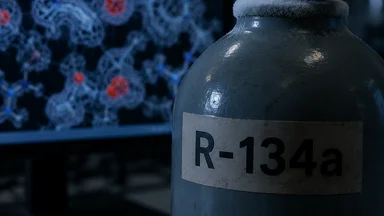
DMF is sold in several grades: ACS reagent (≥99.8%), HPLC grade (≥99.9%), anhydrous (≥99.9%, <0.005% water), and others. The price difference between ACS and anhydrous can be roughly 10-fold. Most labs use ACS grade for routine synthesis, assuming that the 0.2% of unspecified impurities are inert. But in MOF synthesis, where the solvent often acts as a template or modulator, even 0.1% of a reactive impurity like formic acid can alter nucleation rates and crystal morphology.
In the retracted MOF paper, the authors had used a single bottle of ACS-grade DMF from a well-known supplier. Later analysis revealed that the bottle contained roughly 0.1% formic acid, likely from hydrolysis of DMF over time or from a contaminated batch. The formic acid acted as a competing ligand, coordinating to zinc ions and creating larger pores than those formed in pure DMF. When other labs used DMF with lower formic acid content, the pores did not form, and the surface area dropped by nearly 30%.
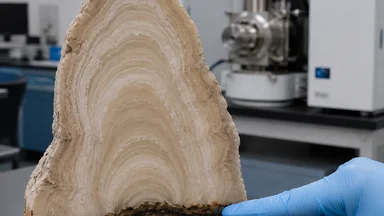
Such impurities are invisible unless specifically tested. Gas chromatography (GC) or nuclear magnetic resonance (NMR) can detect formic acid at the 0.05% level, but these measurements are not standard before every synthesis. A 2018 study tested 20 bottles of ACS-grade DMF from five suppliers and found that formic acid concentrations ranged from below detection limit to 0.3%. No supplier disclosed these variations on the label.
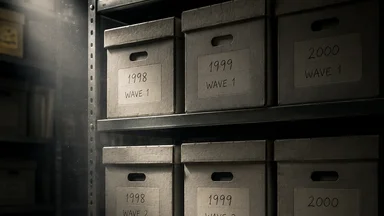
The problem is compounded by the fact that solvents degrade over time. DMF slowly hydrolyzes to formic acid and dimethylamine, especially if stored in partially filled containers or exposed to moisture. A bottle that is pure when opened may develop 0.1% formic acid after six months. Without tracking lot numbers and storage conditions, a lab that successfully replicates a synthesis today may fail six months later with the same bottle.
Publication Pressure Magnifies Small Errors
The MOF field, like many areas of materials science, operates under intense pressure to publish record-breaking properties. Journals often highlight the highest surface area, the smallest pore size, or the largest gas uptake. Negative results — syntheses that fail or produce mediocre performance — are rarely published, so error patterns remain hidden. A 2021 analysis of retractions in chemistry found that roughly 40% were due to irreproducibility, and of those, nearly half involved trace impurities in starting materials.
Funding agencies exacerbate this by tying grants to flashy numbers. A proposal that promises a MOF with a surface area of 5,000 m²/g is more likely to be funded than one that aims for a modest 3,000 m²/g with robust reproducibility. This creates an incentive to push synthesis conditions to the edge of what is possible — and sometimes beyond what is reproducible. The retracted paper's surface area was not fabricated; it was real for that specific solvent lot. But the field treated it as a generalizable result.
The problem is not limited to MOFs. In a 2022 survey of materials scientists, roughly 60% reported that they had encountered irreproducible results in published papers, and of those, 35% said the cause was likely an uncharacterized impurity in a reagent or solvent. Yet fewer than 10% of respondents said they routinely test solvents before use. The culture assumes that commercial reagents are pure enough for research purposes, an assumption that the DMF case has shown to be fragile.
Some argue that the burden should be on publishers, not individual labs, to enforce reporting standards. A 2023 editorial in a leading chemistry journal called for mandatory submission of purity certificates for all solvents and reagents in synthesis papers. The proposal met with mixed reactions: some editors worried it would slow peer review, while others argued that it would catch errors early. As of early 2025, only a handful of journals have adopted such requirements.
Instrumentation Gaps in Routine Synthesis
Most synthetic chemistry labs lack the equipment for on-line purity monitoring of solvents. A basic gas chromatograph costs roughly $15,000–$30,000, and a NMR spectrometer costs ten times that. Many labs rely on shared instruments that may not be available before every synthesis. Water content sensors are relatively cheap (under $1,000), but they only measure water, not organic impurities like formic acid. The cost of high-purity solvents can be 10 times that of standard grades, and for labs on tight budgets, the trade-off is often accepted.
A 2024 study estimated that routine GC testing of every solvent bottle before use would add roughly $50–$100 per synthesis in a typical academic lab. For a lab running 100 syntheses per year, that is $5,000–$10,000 — not a trivial amount, but far less than the cost of failed experiments and retractions. The same study found that the retracted MOF paper alone had cost the broader community an estimated $500,000 in wasted reagents, labor, and instrument time over two years.
Some labs have begun to adopt a "two-bottle" rule: always test a new solvent lot against a known control synthesis before using it in a new project. This simple practice would have caught the DMF impurity in the retracted paper. But it requires discipline and record-keeping that is not always enforced in fast-paced research groups. Graduate students and postdocs, under pressure to produce results quickly, often skip such checks.
Instrument manufacturers have started to market compact, affordable GC units designed for solvent quality control. A 2025 product from a major supplier costs roughly $8,000 and can detect formic acid at 0.01% in under 10 minutes. Adoption is still low, but early adopters report fewer reproducibility headaches. The challenge is cultural: many chemists still view solvent testing as unnecessary unless a problem arises.
Computational Screening Could Catch Solvent Artifacts
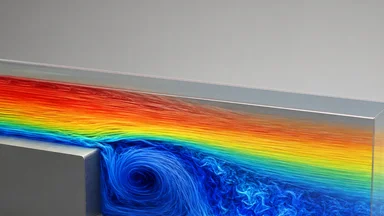
Molecular dynamics simulations can model how solvent molecules interact with MOF precursors during nucleation. In principle, a simulation could predict whether a 0.1% impurity of formic acid would alter pore formation. A 2022 study did exactly that for the retracted MOF system, showing that formic acid molecules compete with the organic linker for zinc coordination sites, leading to larger pores. The simulation matched the experimental surface area within 5%.
Machine learning models trained on retracted data can also flag outliers. A 2023 analysis used a random forest classifier to predict which MOF papers in the CoRE MOF database might have unreliable surface areas based on inconsistencies in reported synthesis conditions. The model flagged roughly 12% of papers as potential outliers, though it could not identify the specific impurity. The authors suggested that such models could be used as a pre-screening tool for journal reviewers.
Open databases like the Computation-Ready, Experimental (CoRE) MOF database allow retrospective checks. A researcher can compare their synthesis conditions to those in the database and see if any similar MOFs had reproducibility issues. But uptake is slow: many groups do not deposit their data, and those that do often omit solvent lot information. A 2024 survey found that only 15% of MOF papers included enough detail for a computational reproducibility check.
Some argue that computational screening is not a substitute for careful experimental practice. Simulations are only as good as the force fields and parameters they use, and they may miss impurities that are not explicitly modeled. Still, as computing costs drop and models improve, computational pre-screening could become a routine step in the publication workflow. Journals like the Journal of the American Chemical Society have begun to encourage authors to submit computational reproducibility checks alongside their manuscripts.
Funding Bodies Start Demanding Raw Solvent Records
The National Science Foundation (NSF) and the European Research Council (ERC) have begun to require that grant proposals include data management plans that specify how solvents and reagents will be tracked. As of 2025, several NSF programs in materials chemistry ask for lot numbers and purity certificates in the supplementary information of publications resulting from funded work. The ERC has gone further, mandating that all synthesis data include the supplier, grade, and lot number of every solvent used.
Journal checklists are also evolving. The journal Chemistry of Materials introduced a mandatory reproducibility checklist in 2024 that includes a field for solvent purity. Early feedback from authors has been mixed: some appreciate the guidance, while others find it burdensome. A 2025 editorial noted that the checklist had caught several potential issues before publication, including one case where a lab had unknowingly used a contaminated solvent batch.
Small labs, especially those in low-resource settings, struggle with the added administrative load. A principal investigator at a mid-sized university told a reporter that tracking lot numbers for every bottle requires a dedicated lab manager, which many groups cannot afford. Some argue that the responsibility should fall on suppliers, not researchers. A 2023 petition called on solvent manufacturers to print lot-specific purity data on every bottle, but only one major supplier has agreed to do so as of early 2026.
Industry partnerships are pushing for traceable supply chains. Pharmaceutical companies, which rely on reproducible syntheses for drug development, have long required purity certificates for all reagents. Some are now extending these requirements to their academic collaborators. A 2024 agreement between a major pharma company and a university consortium included a clause that all solvents used in collaborative research must be from lots with documented purity. The cost of compliance is shared, but it still adds overhead.
An Ongoing Challenge, Not a Solved Problem
The DMF impurity case is a stark reminder that reproducibility in materials synthesis is not simply a matter of good intentions or careful technique. It requires a systematic approach to tracking the invisible variables that can shift from one bottle to the next. The retracted MOF paper was not an anomaly; it was a symptom of a culture that prizes novelty over robustness. Despite increased awareness, the field still lacks universal standards for solvent reporting, and many labs continue to operate under the assumption that commercial reagents are interchangeable.
Open questions remain. How many other retracted or corrected papers are lurking in the literature, their failures attributed to human error rather than untracked impurities? Can computational screening ever replace the need for experimental validation? And will the added administrative burden of lot tracking disproportionately affect smaller labs, widening the gap between well-resourced and under-resourced groups? These questions do not have easy answers. What is clear is that the MOF field, and materials science more broadly, must move beyond the notion that reproducibility is a problem to be solved once and for all. It is an ongoing discipline, one that requires constant vigilance and a willingness to question the purity of even the most mundane reagents.