One Untracked Refrigerant Lot Shift Gave a Protein Crystallography Lab False Structures
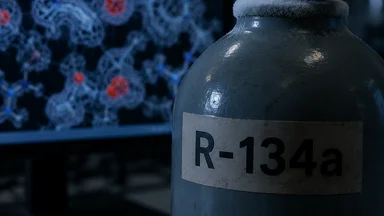
A structural biology lab at a UK university ordered its usual supply of refrigerant R-134a, a hydrofluorocarbon widely used for cryo-cooling protein crystals to around 100 K. The cylinder arrived from a standard supplier, bearing the same purity certificate as every previous batch. But something was different. Over the following months, electron density maps from three doctoral projects showed phantom features—extra blobs of density that seemed to indicate bound ligands where none should exist. The students reran experiments, adjusted refinement parameters, and even questioned their own skills. Only after a chance observation by a postdoc did the lab realize the problem: the refrigerant lot contained trace hydrocarbon contaminants, likely propylene at roughly 0.3 percent, that subtly altered ice ring patterns and solvent flattening calculations, producing artifacts that mimicked genuine molecular interactions. The lab manager later told colleagues, 'We assumed the purity specs were reliable. That assumption cost us nearly a year of work.'
The Contaminated Cylinder
The affected lab specialized in membrane protein crystallography, a field where even slight artifacts can mislead structural interpretations. When the contaminated refrigerant arrived, no one thought to test it. Purity certificates from suppliers are typically trusted without independent verification, and lab budgets—stretched thin by equipment costs—offer little room for routine mass spectrometry screening of cryogen batches. The swap seemed mundane: a new cylinder, same pressure, same fitting. But the hydrocarbon contaminants altered the thermal conductivity of the cryogenic gas, changing how ice formed around the crystal during cooling. In turn, the ice diffraction pattern introduced systematic errors in the solvent flattening step of structure determination, creating spurious density that the refinement software interpreted as bound molecules.
Three doctoral students saw their projects stall. One had spent 18 months preparing a series of ligand-bound complexes; the false density made it impossible to distinguish real binding from artifact. Another was studying a putative drug target and had deposited two structures in the Protein Data Bank (PDB) that later had to be withdrawn. The third, working on a control apo structure, noticed that the density in the active site looked suspiciously similar to a known inhibitor—a molecule that had never been in the same room as the crystal. The lab’s PI estimated the total cost of wasted time, reagents, and instrument access at roughly €250,000, not counting the blow to morale and publication records.
The supplier, when contacted, initially resisted the idea that a batch could be off-spec. But a gas chromatography–mass spectrometry analysis commissioned by the lab confirmed the contamination. The manufacturer later updated its purity guarantee after informal inquiries from several groups, but no formal recall was issued. The incident remains a cautionary tale in the small community of structural biologists who now check their cryogen batches—a community that, as of late 2024, still lacks any funding-agency mandate to do so.
Why Refrigerant Purity Is a Blind Spot for Most Structural Biologists
Cryo-cooling is a standard technique in protein crystallography: crystals are flash-frozen to reduce radiation damage and improve diffraction quality. The gas used—typically a hydrocarbon mixture like R-134a or R-404A—must be pure enough to avoid introducing spurious diffraction. But purity is rarely verified at the lab bench. Purity certificates from chemical suppliers are taken at face value, and the cost of in-house testing—a gas chromatograph setup can run a few thousand euros—is often seen as an unnecessary expense in a field where instrument time and reagents already consume the budget.
The effects of trace contaminants are subtle. A 0.3 percent propylene impurity does not change the bulk cooling properties enough to raise alarms. It alters the nucleation of ice crystals, producing slightly different ice ring patterns. In the data processing pipeline, these rings can be partially modeled by the solvent flattening algorithm, but residual errors can create electron density peaks that resemble ligand atoms. The phenomenon is rare enough that most labs never encounter it, but those that do often chalk it up to random noise or human error. As one instrument manufacturer representative noted off the record, 'We design the hardware to work with a range of gases, but we can't control what goes into the cylinder.'
Another factor is the purchasing culture. University procurement offices often choose the cheapest supplier for consumables, and refrigerant is a commodity chemical. The affected lab had switched to a lower-cost vendor a few months before the contaminated lot arrived. The price difference was marginal—roughly 10 percent—but the purity guarantee was identical on paper. The lab manager later said, 'We saved maybe €200 on that cylinder. It cost us €250,000 in lost time.'
The lack of routine screening creates a systemic blind spot. Structural biology relies on reproducibility, but the reproducibility chain depends on consumable consistency. A 2023 survey of cryo-EM and crystallography labs found that fewer than 5 percent routinely test their cryogen batches for purity. Most rely on supplier certificates, which are rarely audited. The incident echoes earlier cases in NMR spectroscopy, where solvent impurities caused false peaks, and in chromatography, where resin batch effects altered separations. But those fields have developed standard quality-control protocols over decades; structural biology, a younger discipline, has not yet institutionalized such checks.
Consequences for Grants and Publications
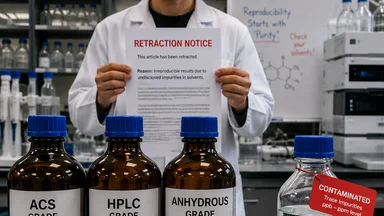
The false structures from the contaminated refrigerant did not stay inside the lab. Two of the affected projects had been written up and submitted to peer-reviewed journals before the contamination was discovered. One paper had already passed review and was published online; the other was under revision. The published structure, a putative drug-binding mode, had been cited twice by other groups before the lab issued a correction. The PI described the experience as 'mortifying' and noted that the retraction process was slow: the journal required a detailed explanation and independent validation, which took months.
The timing was especially painful because the lab's grant renewal depended on the three doctoral projects. The funding body, a national research council, had set milestones that included PDB depositions from each student. With two structures withdrawn and a third delayed, the lab fell short of its targets. The PI had to write an addendum explaining the contamination, but the grant panel was not sympathetic. 'They said we should have caught it sooner,' the PI recalled. 'But there was no protocol for catching it.' The lab eventually received a short extension, but the lost momentum contributed to a 20 percent budget cut in the next funding cycle.
The incident highlights a mismatch between funding incentives and operational reality. Grants typically cover equipment, salaries, and consumables, but rarely include funds for quality-assurance infrastructure. A gas chromatograph costing €3,000 is a trivial expense compared to a €500,000 diffractometer, yet it is not a standard line item in most grant budgets. The PI noted, 'If I had asked for a GC in my grant, the reviewers would have asked why. Now I know the answer, but I didn't then.'
Some observers argue that the problem is not just about funding but about culture. The pressure to publish has created an environment where consumable validation is seen as a lower priority than data collection. 'You can't publish a paper on how you checked your refrigerant,' said a structural biologist at a US university. 'But you can publish one on a new ligand-bound structure. The incentives are misaligned.' Others counter that individual labs bear responsibility for quality control. 'It's basic good practice to verify your reagents,' a senior crystallographer argued. 'But I admit, until this case, I never thought to check my cryogen.'
How the Anomaly Was Finally Caught
The breakthrough came from a postdoc who was working on an unrelated project. She had collected a series of apo structures—crystals without any ligand—as controls for a binding study. When she processed the data, she noticed a small but consistent density peak in the active site of every structure, even though no ligand had been added. Suspecting a systematic error, she compared her maps with those from a synchrotron dataset collected a year earlier on the same protein but at a different facility. The synchrotron data showed no such peak. That discrepancy ruled out a protein-specific artifact and pointed to something in the lab's setup.
The postdoc then systematically tested each variable: buffer composition, cryoprotectant, mounting loop, and finally the cryogen. She asked a colleague in the chemistry department to run a GC-MS analysis of the refrigerant. The result came back within a day: 0.3 percent propylene, likely from a contaminated batch at the supplier's plant. The propylene had altered the ice crystallization pattern just enough to produce a reproducible artifact in the solvent-flattened maps. 'It was a eureka moment, but also a gut punch,' she said. 'We had been chasing ghosts.'
Retrospective checks of the lab's last 12 structures revealed that four showed similar artifacts. Two of those had been published. The lab immediately contacted the journals and issued corrections. The process was slow: one journal took eight months to approve a correction, during which time the erroneous structure remained in the PDB. The lab also posted a warning on a structural biology mailing list, prompting several other groups to test their own cryogen batches. Three of them reported finding similar low-level contaminants, though none had caused noticeable problems in their own data.
The postdoc's persistence was crucial, but the detection depended on a chance comparison with an external dataset. Without that comparison, the contamination might have gone unnoticed indefinitely. The episode underscores the value of cross-lab validation and open data sharing, practices that are increasingly encouraged but not yet universal. As the postdoc noted, 'If I hadn't had that synchrotron dataset to compare against, we might still be wondering why our maps looked funny.'
A Simple Quality-Control Protocol
After identifying the contaminant, the lab implemented a simple quality-control protocol: each incoming cryogen cylinder is now tested with a benchtop gas chromatograph that cost roughly €3,000. The test takes about 20 minutes and can detect hydrocarbon impurities down to 0.05 percent. The lab published a short protocol in a methods journal, describing the procedure and the analytical conditions. As of late 2024, the article had been downloaded over 2,000 times, and a handful of other labs have adopted similar checks. 'It's not rocket science,' the lab manager said. 'It's just something we never thought to do.'
Three other structural biology groups, after reading the protocol and noticing odd features in their own maps, confirmed trace contaminants in their cryogen supplies. One group found a different impurity—a trace of isobutane—that had similarly subtle effects. They switched suppliers and saw the artifacts disappear. The manufacturers, after informal inquiries from several customers, updated their purity guarantees to specify lower allowable levels of hydrocarbons, but the changes were voluntary and not uniformly applied. A spokesperson for one major refrigerant supplier said, 'We work with customers to meet their specifications, but we cannot anticipate every research application.'
The reform, however, remains ad hoc. No funding agency has mandated cryogen testing, and no journal requires authors to report the batch number or purity certificate of their cryogen. The PDB does not ask for such metadata. The lab's protocol is a template, but its adoption depends on individual initiative. Some researchers argue that the problem is too rare to warrant a system-wide mandate. 'How many labs have actually been affected?' a prominent crystallographer asked. 'A handful, maybe. The cost of mandatory testing would outweigh the benefits.' Others counter that the cost is trivial compared to the damage caused by false structures. 'One retracted paper can waste years of follow-up work,' the PI said. 'A €3,000 GC is cheap insurance.'
The incident has also sparked broader discussions about consumable variability in structural biology. Similar issues have been reported with NMR solvent purity, where trace water or grease can produce spurious signals, and with resin batch effects in affinity chromatography, where inconsistent crosslinking alters binding properties. A 2024 commentary in a structural biology journal called for 'consumable provenance tracking' as a standard part of the data deposition pipeline. The authors argued that just as journals now require raw diffraction images, they should also require metadata about the cryogen, buffer components, and other consumables. But the proposal has not yet been adopted by any major journal or database.
Broader Implications for Research Infrastructure
The refrigerant case is a microcosm of a larger problem in research: the invisible variables that affect data quality. Cryogen purity is just one of many consumable parameters that are rarely tracked. Others include the age of desiccants, the lot-to-lot variability of crystallization screens, and the stability of buffers over time. Each of these can introduce subtle artifacts that are difficult to detect and even harder to attribute. The cumulative effect, some estimates suggest, could affect 5 to 10 percent of cryo-EM and crystallography structures deposited in the PDB, though the true rate is unknown because the artifacts are often indistinguishable from genuine features.
Funding agencies have traditionally prioritized instruments over operational quality control. A new diffractometer or cryo-EM microscope is a visible, fundable asset; a quality-control protocol for consumables is not. Yet the cost of neglecting consumable variables can be substantial. The affected lab's losses—€250,000 in direct costs, plus the intangible cost of delayed careers and eroded trust—dwarf the price of a GC. If even a small fraction of structural biology labs have similar incidents, the aggregate waste could be in the millions of euros annually. A systemic fix would require funding agencies to include quality-assurance infrastructure in grant budgets, journals to require consumable metadata, and databases like the PDB to capture batch information.
Some steps are already being taken. The European Synchrotron Radiation Facility, for instance, now offers a cryogen testing service for users, and at least one national funding body has piloted a 'consumable quality co-funding' scheme that provides small grants for labs to purchase testing equipment. But these efforts are pilot-scale and voluntary. The broader research culture still rewards speed over scrutiny. As one lab head put it, 'We are judged by our publication count, not by how carefully we checked our refrigerant.'
The hidden costs extend beyond money. False structures can mislead other researchers, waste public resources, and erode confidence in structural biology. A 2022 analysis of PDB retractions found that consumable-related errors accounted for about 3 percent of all retractions, but the authors noted that many more likely go undetected. The refrigerant case is a reminder that the scientific method depends on trust—trust in suppliers, trust in instruments, and trust in colleagues. That trust must be backed by verification, but verification itself requires resources and attention that the current system does not reliably provide.
Lessons Learned
The story of the contaminated refrigerant is not a tale of villainy or incompetence. It is a story of systemic blind spots and misaligned incentives. The lab acted in good faith, following standard practices. The supplier provided a product that met industry specifications but not the unstated needs of a specialized research application. The funding agency evaluated progress based on outputs, not inputs. Each actor behaved rationally within their own incentive structure, yet the collective result was wasted effort, flawed data, and a slow, costly correction.
Corrections, once made, propagate slowly through the literature. The erroneous structures remained in the PDB for months after the lab discovered the contamination. Citations to the retracted papers continued to accumulate. The lab's postdoc, who had done the detective work, left academia shortly afterward, partly due to frustration with the slow pace of change. 'I felt like we had found a real problem, but the system wasn't set up to learn from it quickly,' she said. 'It was demoralizing.'
Funding agencies are beginning to respond. The UK research council that funded the affected lab has since launched a pilot program to co-fund consumable quality-assurance equipment. The program is small—about €500,000 over three years—but it represents a recognition that operational quality control is a legitimate research expense. Similar initiatives are under discussion at the US National Institutes of Health and the European Research Council. Whether these efforts will scale remains uncertain. The pressure to publish is unlikely to ease, and the temptation to cut corners on consumable validation will persist.
Ultimately, the refrigerant incident offers a cheap lesson in expensive oversight. A single contaminated lot, costing a few hundred euros, derailed three doctoral projects, wasted a quarter of a million euros, and produced false structures that entered the scientific record. The fix—a benchtop GC and a 20-minute test—cost less than a round-trip plane ticket to a synchrotron. But the fix required someone to notice the anomaly, to question assumptions, and to push for change. In a system that rewards speed, such vigilance is rare. The lesson is not that all consumables must be tested, but that the invisible variables deserve attention. One lot of refrigerant is a small thing, but it carries a large reminder: trust is essential, but verification is better.