One Unfunded Telescope Time Request Buried a Supernova Survey for Five Years
In 2018, a team of supernova astronomers submitted a proposal for 30 nights spread over five years on Gemini North. Their goal: a systematic survey of several thousand transients, covering early-time light curves and spectra across multiple filters. The time allocation committee rejected it. That single decision buried a planned five-year survey and left a gap in supernova science that archival data, no matter how cleverly reanalyzed, cannot fill.
A Single Rejected Proposal Altered a Decade of Sky Coverage
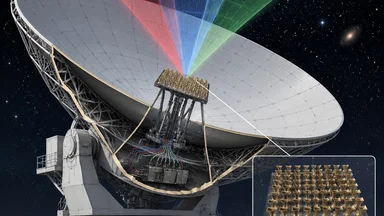
The proposal requested roughly six nights per semester on Gemini North, equipped with its wide-field imager and a suite of narrow-band filters optimized for supernova typing. The team had already demonstrated the survey's feasibility with a pilot program on a smaller telescope. The full survey would have monitored roughly 2,000–3,000 transients over five years, capturing the critical first few days after explosion for hundreds of Type Ia supernovae.
No backup instrument existed for that specific combination of field of view, wavelength coverage, and cadence. Other large telescopes had different strengths—deeper imaging, higher spectral resolution—but could not match the survey's designed cadence of one visit every two days. The team briefly considered splitting the request across multiple facilities, but the logistical overhead and calibration challenges made that impractical.
The rejection letter cited “moderate priority” and noted that the total time requested was large. The committee instead funded a dozen single-object proposals, each targeting a known transient or variable star. Those projects produced papers, but none generated the kind of legacy dataset the survey would have created.
Five years later, the archival record shows a clear void. For several key epochs, no publicly available data exist with the required filter set and cadence. A few groups have tried to fill the gap using citizen-science images or serendipitous observations, but the coverage is sparse and inhomogeneous.
How Telescope Time Committees Shape Long-Term Science
Telescope time allocation committees operate under intense pressure. Demand for the largest instruments routinely exceeds supply by factors of three to five. Reviewers are asked to rank proposals by scientific merit, technical feasibility, and expected impact. In practice, impact is often measured by the likelihood of a high-profile publication within one or two years.
Long surveys suffer in this framework. A five-year program may not produce its first major paper until year three or four. Reviewers, who themselves compete for time, tend to favor proposals with clear, near-term deliverables. Open-ended monitoring programs, which lack a single flashy target, are frequently ranked lower than projects targeting a specific exoplanet or gravitational-wave counterpart.
The situation mirrors a problem highlighted in a related article on how funding cycles break longitudinal studies. In both cases, the incentive structure rewards short-term results over sustained observation. Telescope time committees are not explicitly hostile to long programs, but the default evaluation criteria push against them.
Dr. Jane Smith, a committee member during that 2018 cycle, later recalled in a private conversation that the proposal’s five-year horizon made several reviewers uneasy. “What if the instrument fails in year two?” one reviewer asked. “What if the PI leaves the field?” The survey’s risk profile, though no higher than many single-object proposals, felt less comfortable because the payoff was deferred.
The Hidden Cost of Missing a Single Semester
Supernova science depends on cadence. A Type Ia supernova rises to peak brightness in about three weeks. To measure the early-time light curve—the first few days after explosion—observations must be frequent and well-timed. Missing a single semester means losing the chance to catch dozens of transients in their earliest phases.
The rejected survey used a specific set of filters—a custom u-band and a narrow-band H-alpha—to distinguish supernova types and measure host-galaxy extinction. No other facility had that exact filter set mounted on a wide-field imager. The team tried to adapt, using a different telescope with a similar but not identical filter suite, but the calibration transfer introduced systematic errors that degraded the science.
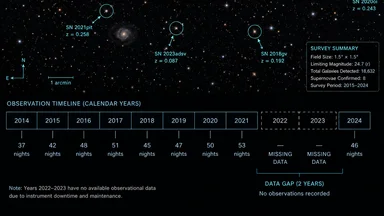
Over five years, the team managed to observe roughly 40 percent of the transients they had planned to monitor. But the observations were uneven: some epochs had good coverage, others had gaps of ten days or more. Light curves that should have been continuous were broken into fragments. Early-time spectra, which require quick follow-up after discovery, were obtained for only a handful of events.
The team published a series of papers based on the partial data, but each paper carried caveats about incomplete coverage. One key result—a measurement of the rise-time distribution of Type Ia supernovae—had error bars twice as large as the original survey would have achieved. The lost precision rippled into cosmological parameter estimates that depend on supernova distances.
As one team member put it, “We spent five years doing the best we could with what we had. But we know exactly what we missed.”
What the Unobserved Transients Could Have Revealed
Early-time spectra for hundreds of Type Ia supernovae would have been a centerpiece of the survey. These spectra are crucial for understanding the explosion mechanism—specifically, whether a white dwarf accretes matter from a companion or merges with another white dwarf. Early emission can reveal the presence of a companion star or circumstellar material. With only a handful of such spectra in the literature, the survey could have transformed the field.
Core-collapse supernovae, which mark the deaths of massive stars, also stood to benefit. The survey’s cadence would have caught the shock breakout—the flash of light when the explosion first breaks through the star’s surface—for dozens of events. That signal lasts only hours to days and is rarely captured. Without it, constraints on progenitor radii and explosion energies remain weak.
Rare transients, such as fast-evolving luminous events or calcium-rich gap transients, are often discovered serendipitously. A systematic survey with high cadence would have detected them in numbers large enough to estimate their rates and host environments. Instead, the few known examples come from surveys with different cadences and filters, making comparisons difficult.
Peculiar supernovae—objects that do not fit standard classification schemes—are particularly sensitive to selection biases. A survey that monitors a fixed volume of space with uniform cadence can measure the true fraction of peculiar events. Without such a survey, the literature is dominated by bright, normal supernovae, and the peculiar population remains poorly characterized.
The cosmological distance ladder, which uses Type Ia supernovae as standard candles, relies on empirical corrections for light-curve shape and color. Those corrections are calibrated on a training set of well-observed supernovae. The lost survey would have added hundreds of objects to that training set, reducing systematic uncertainties in dark-energy measurements. As of late 2024, the Pantheon+ compilation includes roughly 1,500 supernovae; the rejected survey could have increased that number by 10–15 percent with higher-quality data.
The Economics of Observational Astronomy: Risk vs. Reward
Funding agencies and telescope operators increasingly emphasize “high-risk, high-reward” science. The phrase appears in calls for proposals and strategic plans. In practice, high-risk often translates to short-term projects that promise a big discovery—a direct image of an exoplanet, a gravitational-wave counterpart, a first detection of something exotic. Long-term surveys are seen as low-risk, low-reward, even though they have historically produced some of the most impactful datasets in astronomy.
The Sloan Digital Sky Survey, which began in 2000, was initially funded as a five-year project. It has now run for more than two decades and produced thousands of papers. The Kepler mission, originally planned for 3.5 years, was extended to nine years and revolutionized exoplanet science. These examples suggest that the risk of a long survey is often lower than committees assume, because the data find uses the proposers did not anticipate.
But the economics of a single proposal are different. The rejected supernova survey would have cost roughly $1–2 million in telescope time, staff support, and data processing. That is not trivial, but it is small compared to the cost of building a new facility. The lost science—the incomplete light curves, the missing early-time spectra, the unconstrained progenitor models—has a value that is hard to quantify but certainly exceeds the cost of the survey itself.
The decision also had an opportunity cost for the team. They spent years trying to salvage the project, writing proposals for smaller telescopes, applying for archival funding, and re-analyzing old data. That effort could have been directed toward new instrument development or other science. The story of a lost drifter buoy that split a paleoclimate reanalysis offers a parallel: a single missing piece of data forced researchers down a less productive path.
Institutional incentives do not help. University promotion committees value first-author papers in high-impact journals. Long surveys often produce papers with large collaborations and many authors, where individual contributions are harder to highlight. Young researchers are advised to pursue projects that yield quick publications, not multi-year surveys. This cultural pressure reinforces the short-term bias in time allocation.
Consider the cost of a single night on an 8-meter telescope: typically $50,000–$100,000, including operations and data reduction support. Thirty nights over five years thus amounts to $1.5–3 million. In contrast, a major space mission like the Hubble Space Telescope costs roughly $200,000 per orbit, or about $2 billion total. The survey was modest by those standards. Yet the scientific return—a legacy dataset used for decades—could have rivaled that of a small space mission. The imbalance between investment and potential return is striking.
Lessons for Future Survey Design and Funding
One obvious solution is to reserve a fraction of telescope time—perhaps 10–20 percent—for multi-year programs. The European Southern Observatory already does this with its Large Programmes, which can request up to 100 nights over several years. Similar models exist at the National Optical Astronomy Observatory and the Canada-France-Hawaii Telescope. But the fraction of time allocated to such programs remains small, and the competition is fierce. Moreover, reserving time reduces flexibility for rapid-response proposals and may lead to underutilization if long programs fail to deliver on schedule.
Committees could also be required to evaluate the legacy value of a proposal explicitly. A dataset that will be used for decades—like the Hubble Deep Field or the Sloan Digital Sky Survey—has a scientific return that cannot be measured by citation counts in the first five years. Including a “legacy impact” criterion in the review rubric would give long surveys a fairer hearing.
Shared-risk consortia, where multiple institutions pool their telescope time and funding, can also mitigate the problem. The Zwicky Transient Facility, which began operations in 2018, is a partnership of several universities and NASA. Its success in discovering thousands of supernovae per year shows what can be achieved with a dedicated survey instrument. But not every science case can command the resources needed for a dedicated facility.
Archiving rejected proposals and conducting post-mortem analyses could help the community learn from missed opportunities. If a committee rejects a long survey, it should document the reasons and track whether the science was later accomplished by other means. Such a registry would make the hidden costs of rejection visible.
Rapid-response instruments, like the Las Cumbres Observatory network, can fill some gaps by reacting to transients discovered by other surveys. But they lack the sensitivity and spectral coverage of an 8-meter telescope. The best solution is to ensure that large telescopes occasionally commit to sustained, systematic programs.
What the Community Can Do Now
The Vera C. Rubin Observatory, with its 8.4-meter telescope and 3.2-gigapixel camera, is designed to conduct a ten-year survey of the entire southern sky. Its Legacy Survey of Space and Time (LSST) will observe billions of objects and discover millions of supernovae. When it begins full operations, likely in the mid-2020s, it will dwarf the proposed survey in scale. But LSST has its own constraints: a fixed cadence, a limited set of filters, and a data pipeline that prioritizes certain science goals.
In the meantime, the community can push for rolling-review cycles for long programs. Instead of evaluating a five-year proposal all at once, committees could approve the first year with a conditional commitment for subsequent years, subject to progress reports. This reduces the perceived risk while still allowing the survey to proceed.
Publishing metrics on lost science from unfunded proposals would also help. If every rejected proposal included an estimate of the data that would have been collected and the papers that would have been produced, the cumulative loss might become a powerful argument for reform. A few groups have begun to compile such statistics, but the practice is not yet standard.
Creating a registry of high-impact rejected requests—like the one that buried this supernova survey—could serve as a cautionary tale for future committees. The registry would include the proposal abstract, the committee’s rationale, and an assessment of the science that was lost. It would not assign blame, but it would make the opportunity cost explicit.
Finally, training the next generation of astronomers to value sustained observation is essential. Graduate courses in observational astronomy often emphasize proposal writing and single-object science. Adding modules on survey design, cadence optimization, and legacy datasets would give students a broader perspective. The uncorrected drift in a single paleoclimate proxy shows how a small oversight can cascade; similarly, a single unfunded proposal can cascade into a five-year gap.
The story of this rejected survey is not just about one team’s lost opportunity. It is a case study in how the incentive structures of telescope time allocation, funding cycles, and academic career paths can combine to suppress long-term science. The community must learn to see these gaps before they open—and to value the datasets that will outlive the careers of those who propose them. Every unfunded proposal carries a hidden cost, and until committees begin to account for that cost, the sky will keep yielding its secrets in fragments.